
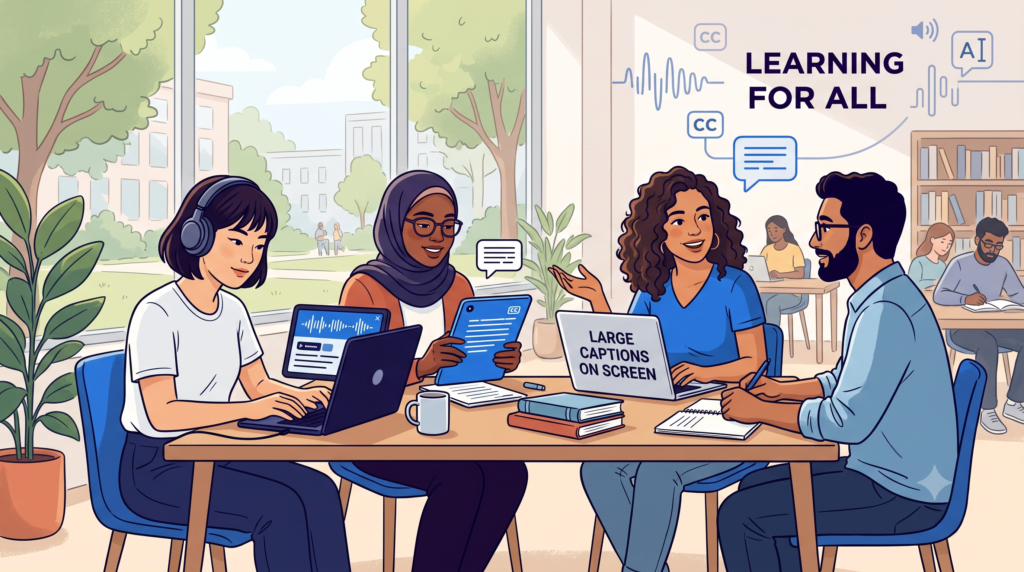
How AI Can Support Disabled Students in Higher Education
Every year I teach students who are brilliant at computing but who hit barriers that have nothing to do with their ability. A dyslexic student who loses marks not on logic but on how long it takes to read a brief. A student with ADHD who can build a working app but cannot sit through a two-hour reading. A student with chronic illness who misses the one lecture that everything else depended on. Artificial intelligence will not remove those barriers on its own, but used well, it can lower a surprising number of them.
This is one of the areas I research, and it is also something I deal with every week in the classroom. So this is less a futurist take and more a practitioner’s view of what is actually helping disabled students in UK higher education right now.
Why accessibility and AI belong in the same conversation
Universities have a legal duty to make reasonable adjustments, but in practice support is often slow, generic, and bolted on after the fact. A student waits weeks for a needs assessment, then receives a tool that was designed for someone else’s needs.
AI changes the economics of that. The same large language models that students use to draft essays can read a dense article aloud, summarise it, rephrase it in plainer language, or turn it into a set of flashcards, instantly, privately, and on demand. That immediacy matters. Support that arrives in week eight is support that arrived too late.
Practical ways AI is helping right now
These are the uses I see making a genuine difference, not the speculative ones:
- Reading and comprehension. Text-to-speech has existed for years, but modern tools also summarise, define jargon in context, and re-explain a paragraph three different ways until one lands. For dyslexic and visually impaired students, this turns an inaccessible reading list into something workable.
- Structuring and planning. Students with ADHD or executive-function difficulties often know what they want to say but struggle to sequence it. AI is good at turning a messy brain-dump into an outline the student can then own and edit.
- Note-taking and transcription. Live transcription and automatic summaries mean a student who cannot write and listen at the same time still leaves the lecture with usable notes.
- Adaptive practice. Tools that adjust difficulty to the learner reduce the overwhelm of being thrown questions that are too hard, or the boredom of ones that are too easy. This connects directly to my work on intelligent tutoring systems.
None of this replaces formal support or specialist staff. It sits alongside them, filling the gap between “I need help now” and “your appointment is in three weeks.”
The risks we have to design around
I would be a poor researcher if I only told you the good half. There are real risks, and ignoring them helps no one.
The first is dependence. A tool that thinks for the student instead of with them undermines the learning it is meant to support. The skill is in designing tasks where AI scaffolds the thinking without doing it.
The second is equity of access. The best assistive AI increasingly sits behind paywalls. If we are not careful, we recreate the exact inequality accessibility work is supposed to dismantle - students with money get the good tools, students without get the free, weaker ones.
The third is privacy. Disabled students are sharing sensitive information with these systems, often without realising where it goes. Institutions have a responsibility to steer students toward tools that handle that data properly.
What good practice looks like
In my own teaching I try to follow a few principles. Be explicit about when and how AI may be used, so disabled students are not left guessing whether they are “allowed.” Design assessment around understanding rather than output, which protects students who use assistive tools from being penalised for it. And treat inclusive design as the default, not a special case, because a clearer brief and a well-structured module help everyone, not only the students with a formal diagnosis.
This is the heart of what I argue in my research: AI in education should be judged not by how clever it is, but by whether it widens participation or quietly narrows it.
FAQ
Does using AI count as cheating for disabled students?
It depends entirely on the institution and the task. Using AI to read, summarise, or plan is usually a reasonable adjustment; using it to generate the assessed work itself usually is not. The key is transparency, students should know the rules, and the rules should be designed so that assistive use is never penalised.
Can AI replace formal disability support?
No, and it should not try to. AI is best understood as a fast, always-available layer that complements specialist staff and formal adjustments, not a substitute for them.
What is the biggest risk of relying on AI for accessibility?
Unequal access. The most capable assistive tools are increasingly paid products, which risks widening the very gaps accessibility work exists to close.
Final thoughts
Used carelessly, AI in education becomes one more thing that advantages students who already had advantages. Used deliberately, it can be one of the most powerful levellers we have seen in higher education. The difference is design, not technology.
If you want to read more about this work, you can find an overview on my research page and the full list of peer-reviewed papers on my publications page. I am Nicki James Shepherd, a Computing Lecturer at Burnley College, more about me here.