“Personalised learning” is one of those phrases that gets stapled onto any product with a login screen. But the idea behind it is genuinely old and genuinely powerful: a good tutor does not teach every student the same way. They watch, they adjust, they push when you are ready and ease off when you are struggling. The question I get asked, by colleagues, by students, and in my research, is whether software can actually do that. The honest answer is: partly, and it is more interesting than the marketing suggests.
What an intelligent tutoring system actually is
An intelligent tutoring system (ITS) is software that tries to do what a one-to-one tutor does: model what a learner knows, decide what to do next, and give feedback that fits. Most systems have three moving parts.
- A model of the domain, what is being taught and how its concepts connect.
- A model of the learner, an estimate of what this particular student currently understands.
- A tutoring strategy, the rules that decide what to show next based on those two models.
The clever bit is the loop between them. Every answer a student gives updates the learner model, which changes what the system does next. That is the difference between a quiz, which asks everyone the same questions, and a tutor, which asks you the right question.
How “adaptive” really works
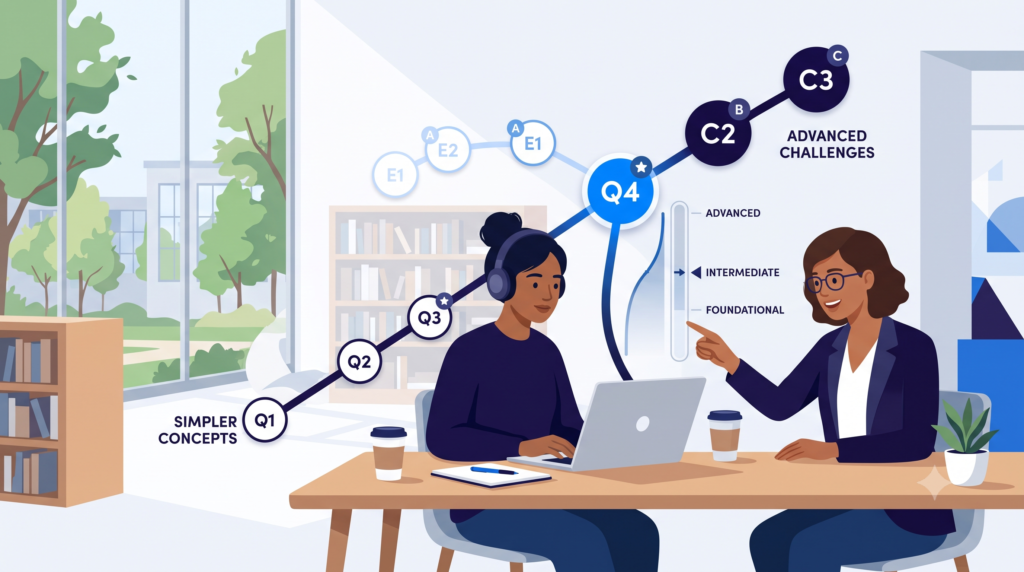
The simplest version of this is something you can feel in a couple of minutes. I built a small adaptive learning demo on this site for exactly that reason, answer a few computing questions and watch the difficulty move with you.
Under the hood, it is doing a stripped-down version of what serious systems do. Get a question right and it nudges the difficulty up; get one wrong and it eases off. After only a handful of questions it has a rough estimate of your level, far faster than a fixed test, which has to ask easy and hard questions to everyone regardless.
That principle, computerised adaptive testing, is the same idea behind exams like the GRE. It is also the foundation that more sophisticated tutoring systems build on, layering in hints, worked examples, and explanations tailored to the specific mistake a student just made.
What the evidence actually says
Here is where I try to be a researcher rather than a salesperson. The evidence for intelligent tutoring is real but modest and uneven. Well-designed systems in well-defined domains, maths, programming, anything with clear right answers, can produce genuine learning gains. Some studies put good tutoring software close to the benefit of a human tutor for certain tasks.
But the wins shrink fast when the subject is fuzzy, when the content is poor, or when the “personalisation” is really just a progress bar with ambitions. A system is only as good as its model of the learner, and modelling a human being from a handful of clicks is genuinely hard.
Where AI changes the picture
The recent leap is that large language models can now generate explanations, hints, and feedback on the fly, in natural language. That removes one of the oldest bottlenecks in tutoring systems: you no longer have to hand-author a response for every possible mistake.
It also introduces new problems. Language models are confidently wrong often enough that an unchecked tutor can teach errors with total fluency. The frontier of this work, and a lot of what interests me, is combining the reliability of a structured tutoring system with the flexibility of generative AI, without inheriting the worst of either.
Can it really replace a teacher?
No, and I do not think it is trying to. The most useful framing I have found is that intelligent tutoring handles the patient, repetitive, individual-pace practice that no human can scale to thirty students at once, which frees the teacher to do the things software cannot: motivate, contextualise, notice the student who has gone quiet, and care.
FAQ
What is the difference between a quiz and an intelligent tutoring system?
A quiz asks everyone the same fixed questions. An intelligent tutoring system updates its estimate of what you know after every answer and changes what it does next, the way a human tutor adjusts in real time.
Does adaptive learning actually improve results?
In well-designed systems and well-structured subjects, yes, the gains are real, though usually more modest than vendors claim. In weak systems, “adaptive” can be little more than branding.
Will AI tutors replace teachers?
Unlikely. They are best at scaling individual practice and feedback, which frees teachers for the human parts of teaching that software cannot do.
Final thoughts
Intelligent tutoring systems are neither magic nor hype, they are a serious, decades-old idea that generative AI has just made far more capable and far more interesting. If you want to feel the core principle for yourself, try the adaptive learning demo, then read more about the research behind it. I am Nicki James Shepherd, a Computing Lecturer and AI researcher.