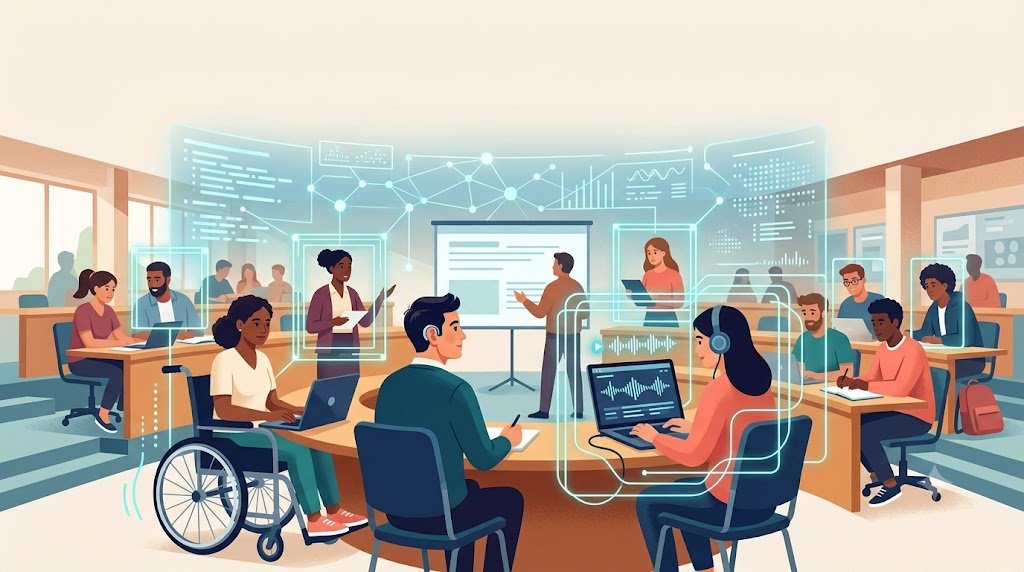
Artificial intelligence is both a teaching area and my active research field. I hold an MRes in Artificial Intelligence and research AI ethics and legal technology - how intelligent systems should be governed, how they affect education, and how they can be used responsibly.
That research feeds straight into the classroom: students build working machine learning systems and learn to reason critically about bias, transparency, and impact - because industry increasingly demands both.
Topics I cover
Machine learning fundamentals
Supervised and unsupervised learning, training and test sets, evaluation metrics, and the workflow of a real ML project - from cleaning data to validating a model honestly.
Neural networks and deep learning
How networks of simple units learn complex patterns: layers, weights, activation functions, and training by backpropagation, implemented in Python with industry-standard libraries.
Applied AI projects
Putting models to work on real problems - classification, prediction, and natural language tasks - with attention to the unglamorous parts that decide success: data quality and evaluation.
AI ethics and responsible use
Bias, explainability, accountability and regulation, drawing on my research in AI ethics and legal tech. As generative AI reshapes both industry and education, these questions are no longer optional.
Explore: inside a neural network
A neural network looks intimidating until you break it into parts. Click or tap each stage to explore it.
How I teach it
Students build models from week one - first with high-level libraries to develop intuition, then digging into what’s underneath so the ideas aren’t magic. Every project includes honest evaluation: what does this model get wrong, and who would that affect?
Because I research this field, course content tracks it closely - students engage with live questions about generative AI, regulation, and responsible deployment, not just last decade’s benchmarks.
Test yourself
Three quick questions - click an answer to check it instantly.
1. Supervised learning requires what kind of data?
2. During training, what does a neural network actually adjust?
3. A model that scores 99% on training data but fails on new data is showing what?
Where this leads
AI skills open doors across the industry - machine learning engineering, data science, and increasingly AI-literacy in every technical role. Students who can build a model and articulate its limits, risks, and legal context stand out sharply in a field that has plenty of hype and not enough rigour.